

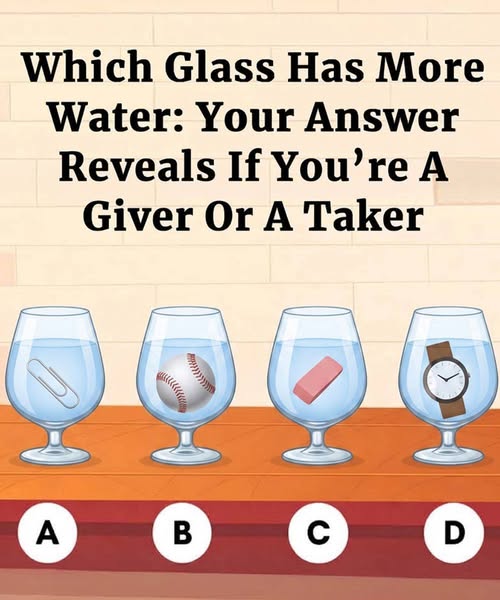
At first glance, the puzzle seems almost too easy to be interesting. Four glasses labeled A, B, C, and D sit side by side, each appearing to contain nearly the same amount of water. But inside each glass is a different object, and that small detail changes the entire answer.
Glass A contains a paperclip.
Glass B contains a baseball.
Glass C contains an eraser.
Glass D contains a wristwatch.
The question sounds simple:
Which glass actually contains the most water?
Most people immediately focus on the visible water levels. Since the glasses appear equally full, the brain naturally assumes the amount of water inside each one must also be nearly identical. That instinctive reaction is exactly what makes the puzzle so effective.
The real solution comes down to one scientific principle: displacement.
Every object placed inside a glass occupies space. The larger the object, the more water it displaces. That means the object itself reduces the amount of actual water that can fit inside the glass.
Vwater=Vglass−VobjectV_{water}=V_{glass}-V_{object}Vwater=Vglass−Vobject
Because the paperclip in Glass A is the smallest object, it takes up the least amount of space. As a result, Glass A contains the most real water, even though all four glasses appear similarly full from the outside.
Meanwhile, the baseball in Glass B displaces a significant amount of volume, leaving much less room for water despite the surface level appearing the same. The eraser and wristwatch fall somewhere in between.
Puzzles like this spread quickly online because they reveal how easily human perception can be fooled. Our brains rely heavily on shortcuts and visual assumptions to make rapid judgments. Most of the time those shortcuts work well, but occasionally a small overlooked detail changes the entire outcome.
That’s also why these riddles feel so satisfying once the answer clicks into place. They force us to slow down, question our first impressions, and think more carefully about what we’re actually seeing instead of what we assume to be true.
Over time, people even turned this puzzle into a playful personality test. Choosing Glass A is often associated with analytical thinking and attention to detail. People who choose Glass B are said to trust intuition and first impressions more strongly. Those who select Glass C are often described as balanced thinkers, while Glass D is linked to more abstract or emotionally intuitive thinking.
Of course, none of those personality descriptions are scientific. They’re simply part of the entertainment. The real lesson behind the puzzle is much simpler and far more universal:
Appearances can be misleading.
Sometimes the smallest detail completely changes the truth. And sometimes, the quietest or least noticeable thing in the room turns out to matter the most.
So the real question is:
Did you pick Glass A immediately, or did the puzzle trick you at first glance?