
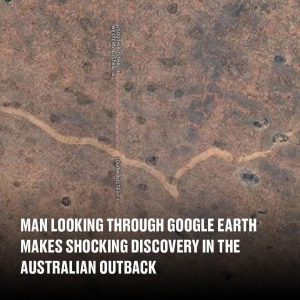
In a quiet corner of the Australian outback, a man made a startling discovery while perusing Google Earth. What appeared to be a strange scar in the landscape turned out to be the aftermath of a powerful tornado, previously unknown to scientists. The finding has captured the attention of researchers, sparking new investigations into the region’s extreme weather patterns. What was once an isolated area in southern Australia has now become the focus of intense scientific curiosity, as experts try to piece together the story behind the tornado that left its mark on the Nullarbor Plain.
The Unexpected Discovery by Google Earth

While exploring satellite imagery of the Nullarbor Plain, a vast, remote region in southern Australia, a caver stumbled upon something unusual. At first, it seemed like just another feature of the arid outback landscape, but closer inspection revealed a long, deep scar stretching across the land. The scar, about 11 kilometers long and up to 250 meters wide, immediately intrigued the man, who had been looking for caves and karst formations in the area. It was a discovery so unexpected that it quickly captured the attention of scientists.
“This scar was a remarkable find,” said Dr. Matej Lipar, an adjunct research fellow at Curtin University’s School of Earth and Planetary Sciences. “What made it so intriguing was that no one had noticed it before. Its sudden appearance was a real puzzle.”
A Closer Look at the Mysterious Scar on Google Earth

The scar, which cuts across the landscape from Western Australia to South Australia, is situated about 20 kilometers north of the Trans-Australian Railway. Despite the region’s remoteness and harsh conditions, it wasn’t long before the find attracted the attention of experts. Dr. Lipar and his colleagues embarked on an expedition to investigate further.
Upon reaching the site, they were stunned by the clarity of the scar’s markings. “The scar is a clear example of nature’s power,” Dr. Lipar explained. “It was created by a tornado so intense, it might have gone completely unnoticed were it not for modern satellite imagery.”
Tornado Patterns Revealed

Upon examining the scar, Dr. Lipar and his team observed distinct cycloidal marks—patterns formed by tornado suction vortexes. These marks were key in identifying the tornado’s strength. “The tornado was likely an F2 or F3 on the Fujita scale, with wind speeds over 200 kilometers per hour,” said Dr. Lipar. The intense winds and unique patterns suggested the tornado was far from ordinary.
The scientists also estimated that the tornado lasted between seven and 13 minutes, a brief but powerful event that left behind a dramatic imprint. “It’s the kind of event that rarely gets recorded, especially in such a remote location,” Dr. Lipar added.
The Timing of the Tornado

The tornado’s occurrence was narrowed down to a specific window in time—between November 16 and November 18, 2022. This timeline was based on comparisons of satellite imagery taken over several years. What’s particularly striking about this timing is that tornadoes in the Nullarbor Plain have only been documented three times before, and all three occurred in November.
“It’s fascinating that tornadoes here seem to occur around the same time every year,” said Dr. Lipar. “It may be a pattern, but we still need to study the meteorological conditions that trigger such extreme events in this area.”
Why the Tornado Went Undetected

One of the most puzzling aspects of this tornado was that it went unnoticed until satellite imagery brought it to light. The Nullarbor Plain is sparsely populated and lacks significant infrastructure, which means tornadoes in the region rarely cause the kind of damage that would attract immediate attention.
“Because there are few witnesses in such an isolated area, many of these events go undocumented,” Dr. Lipar explained. “This scar is proof that even extreme weather events can leave behind traces, even in places where there are no human eyes to see them.”
Tornadoes in the Nullarbor Plain

Interestingly, the Nullarbor Plain has a history of tornadoes, though they are extremely rare. Prior to this discovery, only three tornadoes had been officially recorded in the region. These events were mostly short-lived and did not impact local settlements.
“Because of the geography and lack of infrastructure, the Nullarbor Plain is not a place where tornadoes cause widespread destruction,” said Dr. Lipar. “This is why they often go unnoticed, and it’s also why scientists were so surprised by this discovery.”
A Learning Opportunity for Scientists: Google Earth

The Nullarbor tornado scar presents an exciting opportunity for meteorologists and scientists to learn more about tornado behavior in remote areas. “Studying the scar is vital for improving our understanding of tornado dynamics,” said Dr. Lipar. “It shows how tornadoes can form and leave lasting marks, even in regions where there’s little human interaction.”
This finding also underscores the importance of modern technology in discovering and documenting rare natural phenomena. Satellite imagery and other tools are allowing scientists to uncover secrets that would otherwise remain hidden.
Future Investigations and Insights Through Google Earth

While the discovery of the tornado scar has answered some questions, it has raised many more. As Dr. Lipar and his team continue their investigations, they hope to learn more about the conditions that lead to such powerful storms in the Nullarbor.
“There’s much more to explore here,” said Dr. Lipar. “Understanding why tornadoes happen in this region, and how they form, could have significant implications for forecasting and disaster preparedness, especially in other remote areas.”
The scar in the Nullarbor Plain serves as a reminder of the raw power of nature and how, with the help of technology, even the most remote corners of the Earth can be explored and understood.