
A Growing Sense of Global Anxiety
The news headlines of late have become a breeding ground for existential dread. International tensions have intensified, and global citizens are increasingly left wondering just how close we are to the unthinkable. While conflict has never been far from the headlines, recent events have sharpened the collective fear of a potential nuclear confrontation.
Amid the ever-evolving turmoil in the Middle East, rapid escalations in Asia, and long-standing rivalries between world powers, the thought of nuclear war has gone from distant nightmare to plausible scenario in the minds of many. Politicians trade barbs, ceasefires flicker in and out of existence, and military actions intensify—drawing both public attention and deep concern from intelligence agencies.
But in this sea of anxiety, a chilling yet surprisingly hopeful conversation has emerged: Is there anywhere on Earth you could actually survive a global nuclear exchange? The answer, according to some experts, is yes—though the list is extremely short and not without caveats.
Two Nations That Might Offer a Lifeline
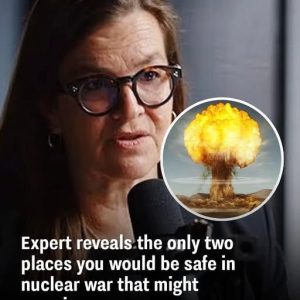
According to investigative journalist and national security expert Annie Jacobsen, there are exactly two places on the planet where humanity might stand a chance if global nuclear conflict were to break out: Australia and New Zealand. Her claim isn’t based on guesswork or sci-fi fantasy. It’s grounded in extensive research into climate models, food sustainability, atmospheric damage, and geopolitical proximity to nuclear powers.
Jacobsen, best known for her deeply researched books on warfare and government secrecy, made the startling claim during an interview with Steven Bartlett on The Diary of a CEO podcast. Her argument was simple and terrifying: nuclear war would result not just in immediate mass casualties, but in long-term climate collapse, agricultural devastation, and eventual mass starvation.
Understanding the Threat: More Than Just Fireballs
Jacobsen explained that the effects of nuclear war extend far beyond the infamous mushroom clouds and shockwaves depicted in media.
“The agricultural zones that feed much of the world, like those in Iowa or Ukraine, would become barren frozen landscapes,” she said. “They’d be covered in snow for up to 10 years. When agriculture fails, people just die.”
But that’s not all. The atmospheric damage caused by nuclear weapons, especially the destruction of the ozone layer, would make it dangerous—even deadly—to be exposed to sunlight. Survivors wouldn’t just need to worry about food; they’d also be forced to seek shelter underground, becoming nocturnal and heavily reliant on stored resources.
Why Australia and New Zealand?
Jacobsen pointed to geographical isolation and climate models to explain why Australia and New Zealand stood out. Both countries are in the Southern Hemisphere—far removed from the anticipated centers of nuclear conflict. More importantly, they possess the right climate, agricultural infrastructure, and relative political stability to potentially continue producing food.
“These are the only places that could actually sustain agriculture,” she said bluntly. “You have to imagine people living underground, fighting for food, everywhere—except for New Zealand and Australia.”
Jacobsen cited updated research from Professor Owen Toon, a physicist and atmospheric scientist, whose work helped revive the nuclear winter theory. According to his models, a large-scale nuclear war—such as one between the U.S. and Russia—could kill as many as five billion people due to food collapse alone. The remaining three billion would likely live in countries untouched by direct strikes and capable of independent food production.
The Math of Survival: Three Billion May Remain
Bartlett, visibly stunned during the interview, posed a question: “So there’d be three billion people still alive. Where should I go to be one of them?”
Jacobsen didn’t hesitate: “That’s exactly where you’d go—New Zealand and Australia.”
Out of Reach: Isolation as Protection
Both countries’ geographic distance from major global powers contributes to their potential as nuclear sanctuaries. Unlike Europe or North America, which are littered with high-value military targets, the Southern Hemisphere is relatively sparse in terms of strategic sites.
Australia and New Zealand are also free from neighboring nuclear powers. They’re not on the borders of hostile nations, and they have few foreign military bases. Their location, coupled with self-sufficient food systems and political stability, makes them ideal in a world where survival depends on sustainability rather than defense.
The Reality of Post-War Life
However, life in these countries wouldn’t be without challenges. Even without a direct strike, they would not escape global economic collapse, radiation fallout, and mass migration. The threat of international refugees fleeing destroyed continents would strain local resources, and governance would be tested in unprecedented ways.
Infrastructure would likely suffer, and societal norms could break down under the pressure of sudden population surges and collapsing global systems. But the fact remains: these two countries would have the best odds at preserving a functioning society.
What About the United States?
Newsweek and Scientific American recently explored this question by examining U.S. nuclear infrastructure, including missile silos and likely strike zones. The studies suggested that nuclear war would center on strategic targets such as silos in Colorado, Montana, Wyoming, Nebraska, and North Dakota.
To destroy a single missile silo, analysts note, attackers would need one or two warheads, each with explosive yields equivalent to 100,000 tons of TNT. The resulting fireballs would vaporize everything nearby and produce shockwaves meant to destroy missile launch tubes.
According to Newsweek’s analysis, states considered safest from direct hits include those on the East Coast and southeastern parts of the country: Maine, New Hampshire, Vermont, Massachusetts, New York, Virginia, Florida, Georgia, and several others.
But “safe” is relative. These areas might avoid immediate annihilation, but they wouldn’t escape radiation, food shortages, and societal collapse.
Global Nuclear Powers: A Dangerous Game
The list of countries with nuclear weapons continues to grow, and with it, the complexity of any potential nuclear conflict. The U.S., Russia, China, France, the U.K., India, Pakistan, Israel, and North Korea each possess varying arsenals and levels of readiness.
While many focus on large powers like the U.S. and Russia, experts warn that smaller regional conflicts—such as between India and Pakistan—could also trigger enough fallout to affect global agriculture. That’s why even seemingly unrelated wars in distant regions matter.
The Psychological Toll of Knowing the Odds
As public awareness of these scenarios grows, the psychological impact is becoming increasingly evident. People are stockpiling emergency kits, discussing bunker installations, and consuming dystopian media with greater urgency.
“We’re seeing a return to Cold War-era fears,” said Dr. Marc Feldman, a disaster psychologist. “But today, those fears are amplified by 24/7 news cycles, social media, and the sheer scale of weaponry available.”
Can We Prevent the Unthinkable?
Experts stress that while these discussions are rooted in worst-case scenarios, the best defense remains prevention. Renewed arms control negotiations, diplomatic efforts, and public awareness campaigns can reduce the risk of full-scale nuclear war.
“We must move away from the mindset of ‘mutually assured destruction’ as our only deterrent,” Jacobsen said. “We need new frameworks for peace, resilience, and international cooperation.”
How to Prepare (Just in Case)
While the hope is that nuclear conflict remains theoretical, some experts recommend basic preparation, especially for those living near known targets. Suggestions include:
Emergency food and water supplies for several weeks
Radiation protection (such as potassium iodide pills)
Communication plans with loved ones
Knowledge of nearby fallout shelters or underground facilities
For those who can afford it, private shelters have become a booming industry, with companies offering everything from underground bunkers to remote survivalist compounds.
Final Thoughts: Hope in Isolation
Though the idea of nuclear war is terrifying, knowledge remains a powerful tool. By identifying safer regions like Australia and New Zealand, humanity retains a sliver of hope amid darkness. These countries are not “safe” in any traditional sense—they would still face hardship—but they stand as beacons of what survival might look like if everything else collapses.
More than just physical refuge, they represent an idea: that with foresight, resilience, and cooperation, not all would be lost.