

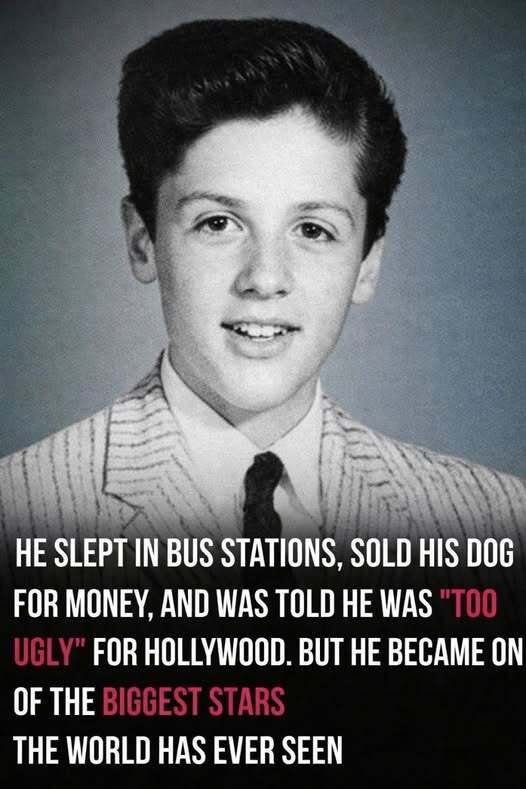
Sylvester Stallone entered the world already carrying a visible difference. A birth complication left part of his face partially paralyzed, affecting both his appearance and his speech. From an early age, this marked him in the eyes of others. Teachers, classmates, and even professionals often treated these traits not as challenges to overcome, but as limitations that defined what he could or could not become. In many ways, the world around him seemed to deliver a quiet but persistent message: that he was “less than.”
Growing up under that kind of perception can shape a person deeply. For Stallone, it meant facing doubt not only from others, but at times from within himself. His slurred speech and distinctive facial expressions made him stand out in ways that were not always kind. He was underestimated, overlooked, and often dismissed. Yet within that experience, something else was forming—a resilience that would later become central to who he was.
What others saw as flaws, Stallone slowly began to understand as something different. They were not simply obstacles; they were part of his identity. Instead of trying to erase them, he started to explore how they could be used. This shift in perspective did not happen overnight. It came through persistence, rejection, and a refusal to accept the limitations placed upon him.
Acting became more than just an interest—it became a purpose. It was the one place where he felt he could transform his struggles into something meaningful. On screen, his voice, his expressions, and his presence were no longer liabilities; they were unique qualities that made him memorable. What had once made him a target for ridicule began to set him apart in a powerful way.
The turning point came when he channeled all of that experience into creating a character that reflected both vulnerability and strength. He understood something others did not: authenticity resonates more than perfection. The pain he had carried, the rejection he had faced, and the determination he had built all became part of his creative process. He was no longer trying to fit into a mold—he was creating one of his own.
In doing so, Stallone transformed the narrative that had been imposed on him. The very traits that once made him a punchline became the foundation of his success. They gave his characters depth, making them feel real and relatable. Audiences connected not because he was flawless, but because he embodied perseverance and humanity.
His story is a powerful reminder that what society often labels as weakness can, in the right context, become strength. It shows that identity is not something to be hidden or corrected, but something that can be shaped into purpose. Stallone did not succeed by overcoming who he was; he succeeded by embracing it fully.
In the end, his journey reflects a deeper truth: limitations are not always what they seem. Sometimes, they are simply the beginning of a different path—one that leads to something uniquely powerful.