
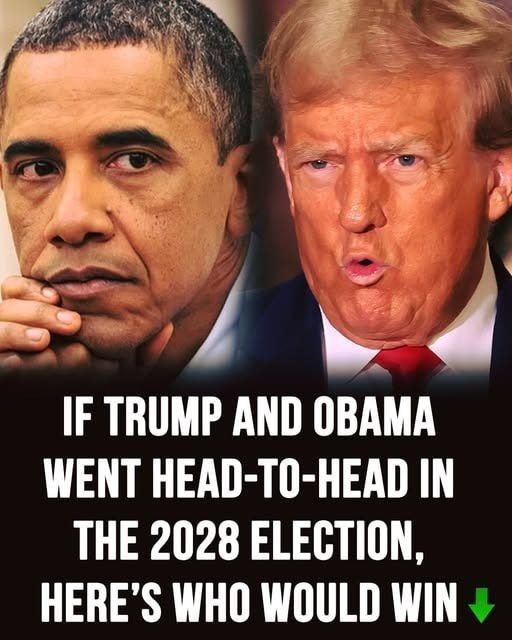
It sounds like something out of political fan fiction — Barack Obama facing off against Donald Trump in a future presidential race. Two of the most dominant and polarizing figures in modern American history, standing across from each other on a debate stage.
Impossible? Technically, yes. But a new poll decided to imagine what would happen if the Constitution didn’t stand in the way — and the results say a lot about where Americans’ loyalties still lie.
The matchup that can’t happen — but everyone wants to talk about
Under the 22nd Amendment, no U.S. president can serve more than two terms. That rule disqualifies both Trump and Obama from ever running again. Obama left office in 2017 after eight years. Trump, after his turbulent exit in 2021, returned to power in 2024 following one of the most divisive elections in modern history.
Still, speculation about “what if” refuses to die. Both men command almost mythic loyalty among their supporters, and the idea of seeing them square off one-on-one has fascinated voters and pundits alike.
Trump himself has done little to quiet the chatter. Asked in April about running against Obama in 2028, the current president grinned and said simply, “I’d love that. That would be a good one. I’d like that.”
Reporters pushed him further. His response — half joke, half provocation — sounded typical Trump: “People are asking me to run for a third term. I don’t know. I never looked into it. They say there’s a way you could do it, but I don’t know about that. I want to do a fantastic job now. We’ve got four years.”
It wasn’t the first time he’d teased the idea. In a separate NBC interview earlier this year, he said, “A lot of people want me to do it. I tell them it’s early — but there are methods. You could do it.”
The comments, while legally meaningless, are politically revealing. Trump thrives on bending norms and daring critics to say “you can’t.” And while Obama has largely stayed out of direct confrontation, his continued popularity — particularly among younger and minority voters — has kept his name alive in every poll testing hypothetical Democratic contenders.
The numbers: Obama wins by double digits
A recent Daily Mail/J.L. Partners survey put the question directly to 1,013 registered voters: If the 2028 election were between Donald Trump and Barack Obama, who would you vote for?
The results were clear — though not surprising.
- 52% said they would vote for Obama
- 41% said they would back Trump
The remaining 7% were undecided or declined to answer.
Obama dominated among minority groups:
- 73% of Hispanic voters said they would choose him.
- 68% of Black voters also sided with the former president.
Even among independents, traditionally the swing bloc in any election, Obama held a strong 10-point lead.
Perhaps most notably, Obama was the only major Democratic figure tested who actually beat Trump in the poll. When voters were asked to choose between Trump and other big names — Hillary Clinton, Kamala Harris, or even Joe Biden — Trump came out ahead. That’s telling. For many Americans, Obama remains the Democratic Party’s last figure of broad, genuine appeal.
Two legacies, one political mirror
In many ways, Trump and Obama define the last 20 years of American politics. Obama’s victory in 2008 reshaped the Democratic coalition, turning out record numbers of young and minority voters. His message of hope, unity, and global diplomacy stood in stark contrast to Trump’s populist nationalism and “America First” doctrine that followed.
Yet their stories are intertwined. Trump’s political rise was, in many ways, built on the backlash to Obama’s presidency — from the birther conspiracy he amplified to his promise to dismantle Obama-era policies.
Obama left office with approval ratings near 60%. Trump entered the White House with one of the lowest inaugural approval numbers in history. And yet, despite impeachment trials, criminal charges, and constant controversy, Trump managed what few thought possible — a return to power in 2024.
They represent opposite political religions: one built on inclusive optimism, the other on grievance and disruption. Both command fervent, unshakable loyalty.
Could Trump actually test the Constitution?
The idea of Trump running for a third term isn’t just a joke to his most die-hard supporters. Some online corners of the right have speculated about legal loopholes or reinterpretations of the 22nd Amendment that could, in theory, allow a non-consecutive third term — similar to Franklin D. Roosevelt’s pre-amendment four terms or Vladimir Putin’s term-reset tactics in Russia.
But the legal reality is blunt: it’s not happening. The amendment clearly caps any president at two elected terms. Changing it would require two-thirds approval in both the House and Senate and ratification by 38 state legislatures — an almost impossible feat in today’s fractured political environment.
Still, in the current climate, “impossible” doesn’t always mean “unthinkable.”
Why Obama still matters
Though long out of office, Obama’s influence hasn’t faded. He remains one of the most admired figures in the world, his post-presidency defined by books, global initiatives, and a carefully managed presence in public life. When he does speak — particularly about democracy, civility, and leadership — his words still make news.
That contrast to Trump’s ever-present, combative media style only amplifies his continued relevance. For many voters, Obama represents stability, intellect, and integrity — qualities they feel have been missing from politics since he left.
For Trump’s base, however, Obama remains the ultimate villain: the smooth-talking liberal globalist who symbolizes everything they believe has gone wrong with America.
The race that never will be — but never really ends
So who would win if the impossible somehow became reality?
According to the data, Obama takes it handily. But numbers aside, the matchup reveals something deeper about the American psyche: nostalgia still trumps novelty. People yearn for the eras that made them feel secure — whether that’s Obama’s calm professionalism or Trump’s promise to fight the “deep state.”
Both men, in their own way, gave their followers a sense of belonging. That’s why, even out of office, they remain cultural forces. And that’s why a hypothetical race between them still captures imaginations.
A fantasy, but a telling one
It’s easy to dismiss the “Obama vs. Trump 2028” scenario as pure fantasy — and legally, it is. But politics isn’t just about laws. It’s about perception, emotion, and identity.
Trump’s teasing about “methods” and “ways” isn’t really about legal strategy; it’s about maintaining power through the idea that he’s unstoppable. Obama’s silence, meanwhile, keeps him above the noise, his legacy growing stronger the less he engages in partisan brawls.
Would he win if he ran again? The numbers say yes. But he won’t. And Trump, for all his bravado, can’t.
Still, the poll’s outcome serves as a reminder of two truths about American politics:
First, the past isn’t past — it’s the most powerful campaign tool there is.
And second, in a country this divided, the race between Obama and Trump never really ended. It just moved off the ballot and into our national psyche.